
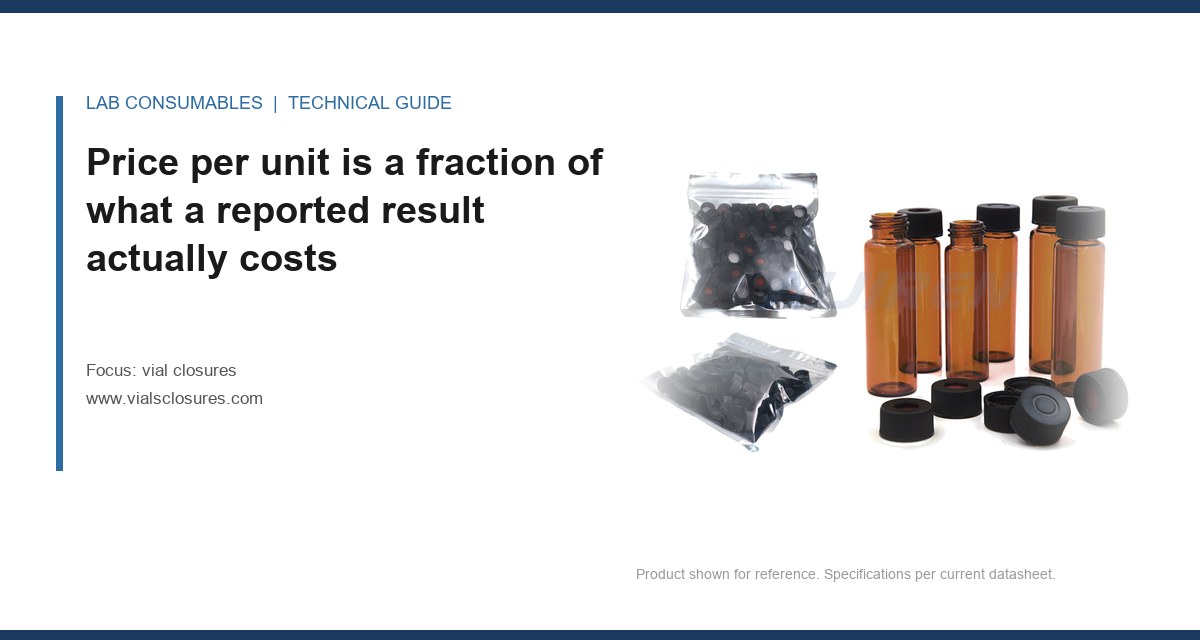
A 96-position HPLC run at a contract lab in Ohio aborted at injection 61 when the autosampler flagged a vial-seat error. The lab had switched to a lower-cost 11 mm crimp closure three weeks earlier to shave $0.019 per unit off its consumables line. The rerun consumed 96 fresh vials, 96 closures, 40 mL of mobile phase, and 2.5 hours of analyst time. That single event cost more than the annual savings on 40,000 units of the cheaper closure. This is the arithmetic most procurement spreadsheets miss when they compare vial closures cost per test calculation against a quoted price per thousand.
Price per unit is a purchase-order number. Price per completed test is a chemistry-and-operations number. They are not the same figure, and on a real workflow they can differ by a factor of three. What follows is how I build the second number, what drives it, and where the two grades of closure most labs actually choose between land on the curve.
Start with the denominator. A single reported HPLC result on a modern system, from vial to LIMS entry, involves roughly:
- One vial and one closure (the parts under discussion)
- Prep time: weighing, dilution, filtration, transfer. Typically 4 to 9 minutes per sample for a simple dissolution assay, longer for extraction methods.
- Instrument time: 12 to 35 minutes of run time per injection on a standard reversed-phase method, plus equilibration and wash cycles amortized across the sequence.
- Data review and QC: a percentage of analyst and reviewer time, plus the bracketing standards and system suitability injections that ride along with every sequence.
If you amortize the instrument, the analyst, and the QC overhead, a reported result on a mid-range HPLC method lands somewhere between $18 and $45 depending on the lab’s loaded labor rate and the method length. The closure contributes between $0.04 and $0.30 of that. So the closure is 0.2% to 1.5% of the true cost of a result. That is exactly why the per-unit price looks like a rounding error and gets treated like one. It is also why the consequences of a bad closure, which multiply the whole $18 to $45 figure, deserve more attention than the $0.02 spread between grades.
You can see the same arithmetic applied to the wider consumables stack at Chromatography Consumables, where the same per-test framing applies to columns, filters, and vials. The closure is the cheapest line item and the one that can invalidate the most expensive ones.
Three multipliers turn a unit price into a per-test cost
The conversion from unit price to per-test cost runs through three multipliers, and each one is measurable if you ask for the right data. Most labs never measure any of them, which is why the spreadsheet stays wrong.
Rerun rate
A rerun is any injection that has to be repeated because the result was not reportable. Closure-related reruns come from three mechanisms: autosampler pickup errors (the needle misses the septum center because the cap is not seated), coring (a plug of septum drops into the vial and the needle pulls it into the sample loop), and evaporation (the seal leaks and the concentration drifts past the method’s acceptance window). Each of these shows up as a different failure signature, but they all land on the rerun rate.
A well-sealed closure on a matched vial runs a rerun rate of 0.5% to 1.5% on a validated method. A poorly seated or dimensionally drifting closure pushes that to 4% to 9%. On a 96-injection sequence, that is the difference between one rerun and eight.
Reject rate at prep
Before the sample ever reaches the autosampler, some fraction of prepared vials gets rejected: septa that are visibly torn, caps that will not crimp square, liners that fall out of the cap during transport, or vials that fail a visual check for particulates. On a manual crimper, a reject rate of 2% to 5% is common with a low-grade closure and a tired analyst. With a pre-assembled, pre-sterilized closure and a calibrated crimper, that drops to under 1%. Every reject is a full prep cycle redone, not just a new cap.
Prep time per closure
The labor of handling the closure itself. A one-piece crimp cap with a loose liner has to be assembled, aligned, and crimped. A two-piece cap has to be seated on the vial before crimping, and a misaligned liner means a re-do. A pre-assembled cap with the liner bonded or pre-seated removes two handling steps per vial. On a 200-sample batch, that is 20 to 40 minutes of analyst time saved, which at a $65/hour loaded rate is $22 to $43, more than the closure cost of the entire batch.
The per-test calculation, worked through
Here is the formula I use. It is not complicated, but almost nobody runs it.
Cost per reported result = (unit price × units consumed per result) + (rerun rate × cost of a rerun) + (reject rate × cost of a reject) + (prep labor per closure)
Where units consumed per result is 1 plus the rerun rate plus the reject rate (because reruns and rejects consume fresh closures). The cost of a rerun is the full $18 to $45 figure above, plus the incremental consumables. The cost of a reject is the prep labor plus the consumables already consumed before the reject was caught.
Run this on a $0.06 closure with a 1% rerun rate, a 1% reject rate, and 20 seconds of prep labor ($0.36 at $65/hour), against a $0.18 closure with a 0.3% rerun rate, a 0.3% reject rate, and 5 seconds of prep labor ($0.09):
- Cheap closure: $0.06 + (0.01 × $30) + (0.01 × $8) + $0.36 = $0.80 per result
- Premium closure: $0.18 + (0.003 × $30) + (0.003 × $8) + $0.09 = $0.38 per result
The cheaper closure is more than twice as expensive per reported result. That is the whole argument, and it holds across a wide range of assumptions. The break-even is not sensitive to the rerun cost; it is sensitive to the rerun rate, which is why the rerun rate is the number you should be demanding from your supplier and measuring in your own lab.
For the material and dimensional side of why the two grades behave differently, see Vial Closures and the dimensional interface discussion there. The per-test math is downstream of the physics.
Two grades, side by side, with the numbers that matter
Most labs choose between a commodity crimp or screw closure and a specified, tested closure. The table below uses real parameters from two representative products. I have kept the column headers generic because the specific part numbers vary by supplier, but the specs are typical of what I see on a datasheet versus what I see on a certificate of analysis.
| Parameter | Commodity closure | Specified/tested closure |
|---|---|---|
| Unit price (11 mm crimp, 1,000-pc pack) | $0.055 to $0.075 | $0.14 to $0.22 |
| Septa material | Natural rubber, unspecified formulation | Silicone/PTFE, USP <381> Type I, tested |
| Septa thickness | Nominal 1.0 mm (±0.15 mm) | 1.0 mm ±0.05 mm, SPC-controlled |
| Crimp OD after sealing | Nominal 11.0 mm, drift to 11.4 mm | 11.0 mm ±0.1 mm, verified |
| Puncture count before coring (0.5 mm needle) | 2 to 4 | 8 to 12 |
| Seal integrity after 24 h at 4 °C | 2% to 6% weight loss on volatile solvent | <0.5% weight loss |
| Extractables (silicone oil, peroxides) | Not characterized | Characterized, lot-tested |
| Observed rerun rate (validated method) | 3% to 9% | 0.3% to 1.5% |
| Observed reject rate at prep | 2% to 5% | <1% |
| Prep labor per closure | 15 to 25 s (assembly + alignment) | 3 to 8 s (pre-assembled) |
| Cost per reported result | $0.75 to $1.40 | $0.35 to $0.55 |
The gap widens on methods that use volatile solvents (methanol, acetonitrile, dichloromethane) or that run over 12 hours, because evaporation and seal creep dominate the rerun rate. It narrows on aqueous methods with short sequences, where the closure barely has time to fail. That is the honest caveat: on a 20-injection aqueous run, the commodity closure is fine and the per-test math favors it. On a 96-injection overnight run with a volatile mobile phase, it does not.
The dimensional and material specifications above are the ones to write into a purchase spec. The Thermo Fisher chromatography and sample handling catalog is a useful reference for the range of formats and the specs that accompany them, and Agilent’s chromatography consumables documentation gives you the instrument-side tolerances your closure has to meet.
Where the per-test math breaks: three field cases
The formula above is a model. Real labs break it in specific ways. Here are three cases where the measurement told us something the spreadsheet did not.
Case 1: the crimper was the variable, not the closure
A pharma QC lab moved from a manual crimper to a pneumatic one and saw its rerun rate rise from 1.2% to 6% over two weeks. The closure was unchanged. The symptom was autosampler pickup errors, concentrated on positions 1 through 12 of each tray. We measured the crimp OD on 50 sealed vials with a digital micrometer: mean 11.28 mm, standard deviation 0.14 mm, with the first twelve vials in each tray running 0.2 mm high. The pneumatic crimper’s jaw was not returning fully between cycles, so the first vials after a pause were under-crimped. The fix was a 30-second jaw-return adjustment and a daily 10-vial crimp-OD check with a go/no-go gauge at 11.0 ±0.1 mm. Rerun rate fell to 0.8% within a week. The per-test cost dropped by $0.42 with zero change in closure price.
Case 2: the septum was coring at puncture 3, not puncture 10
An environmental lab running EPA SW-846 Method 8260 saw intermittent carryover and ghost peaks at the retention time of the internal standard. The closure datasheet claimed 10 punctures. We ran a puncture study on 20 vials from the lot: at puncture 3, three of the 20 septa showed visible coring under a 10× loupe, and the GC-MS confirmed a silicone fragment in the vial. The lot’s septa were 0.85 mm thick, not the 1.0 mm specified, and the needle was a 23-gauge (0.64 mm) rather than the 0.5 mm the spec assumed. The fix was twofold: tighten the incoming septa thickness spec to 1.0 ±0.05 mm with a lot COA requirement, and switch to a 0.5 mm needle for the method. Puncture count before coring rose to 9. The rerun rate on that method fell from 7% to 1.1%. The EPA SW-846 test methods define the data quality objectives; the closure has to meet them, and a nominal thickness spec does not.
Case 3: the reject rate was a liner-alignment problem
A contract lab preparing 300 samples per day for a dissolution assay had a 4.5% reject rate at the visual check, all traced to liners that had shifted off-center in the cap before crimping. The liners were loose, not bonded. The prep tech was assembling cap and liner by hand at a rate of about 400 per hour, and the misalignment rate rose with throughput. We switched to a pre-assembled cap with the liner bonded to the cap interior, which removed the assembly step entirely. Reject rate fell to 0.4%, and prep time per vial dropped from 22 seconds to 6. The per-test cost fell by $0.51, and the lab absorbed a 300-sample day with one fewer technician hour.
These three cases share a pattern: the closure price was never the problem. The crimper, the needle, and the assembly method were. That is why the per-test calculation has to be paired with a measurement plan, not just a purchase spec.
A measurement plan you can run in a week
You cannot calculate per-test cost from a datasheet. You have to measure your own rerun and reject rates. Here is the minimum plan I would run before any closure change or contract renewal.
- Day 1: baseline the current closure. Pull the last 30 days of rerun logs and reject logs. If they do not exist, that is the first finding. Count reruns by cause (pickup error, coring, evaporation, other) and rejects by cause (torn septum, misaligned liner, crimp failure, particulate).
- Day 2: measure the crimp. Seal 20 vials with your current crimper and measure the crimp OD with a micrometer. Target 11.0 ±0.1 mm for an 11 mm crimp. If the standard deviation is above 0.08 mm, the crimper needs service before you evaluate any closure.
- Day 3: run a puncture study. Take 10 vials from the current lot, puncture each septum with your production needle at the production depth, and inspect under a 10× loupe after each puncture. Record the puncture count at first visible coring. Compare to the datasheet claim.
- Day 4: run a seal-integrity check. Fill 10 vials with your most volatile mobile phase, seal, weigh, store 24 hours at your method’s temperature (4 °C or ambient), and reweigh. Weight loss above 0.5% means the seal is not holding.
- Day 5: time the prep. Have one analyst prepare 50 vials with the current closure and 50 with the candidate, and time each set. Record seconds per vial, including assembly and crimping.
- Day 6: calculate. Plug the measured rerun rate, reject rate, and prep time into the per-test formula. Use your own loaded labor rate, not an industry average.
- Day 7: decide. If the per-test cost difference is under 10%, buy on unit price and logistics. If it is over 25%, the per-test number should drive the decision regardless of unit price.
The Analytical Testing resources cover the method-validation side of these measurements, and Restek’s technical resources have useful guidance on septa selection and needle compatibility that will save you a day of the puncture study.
What to put in the purchase spec so the per-test math holds
The per-test calculation is only as good as the closure you actually receive. The spec has to lock the parameters that drive the rerun rate. I would require the following on any closure above the commodity tier:
- Septa thickness: 1.0 mm ±0.05 mm, with a lot COA stating the measured mean and standard deviation.
- Septa material: silicone/PTFE, USP <381> Type I, with extractables characterized.
- Crimp OD: 11.0 mm ±0.1 mm after sealing with a calibrated crimper, verified by the supplier on a sample from each lot.
- Puncture count: stated at a defined needle gauge and depth (e.g., 10 punctures minimum with a 0.5 mm needle at 15 mm depth), with the test method named.
- Seal integrity: weight loss under 0.5% after 24 hours at 4 °C with a defined volatile solvent.
- Liner attachment: bonded or pre-seated, with a stated pull-off force if bonded.
- Lot traceability: resin lot, molding date, and cavity number on the carton, so a rerun spike can be traced to a molding run rather than a supplier.
The dimensional tolerances matter more than the material grade in most rerun scenarios, because a septum that is 0.15 mm thin cores early regardless of what it is made of. If you are sourcing HPLC vials alongside the closures, specify the vial neck OD and the closure together; the interface is what the autosampler sees, and a mismatch shows up as a pickup error that gets blamed on the closure.
The decision rule
Buy on price per unit only when your measured rerun rate is below 2% and your method runs under 12 hours with an aqueous mobile phase. In every other case, calculate the per-test cost from your own rerun and reject logs, and let that number drive the decision. The threshold I use: if the per-test cost difference exceeds $0.20 per reported result, the cheaper unit price is a false economy, and the closure with the tighter dimensional spec and the lot COA wins on the only number that shows up in the lab’s operating budget. Measure the rerun rate before you sign, not after.
References & further reading
Related resources from our lab consumables network:
- Vial Closures at vialsclosures.com
- Analytical Testing at testinganalytical.com
- Hplc Vial at vialforhplc.com
- Chromatography Consumables at chromatographyconsumables.com
External references and standards: