
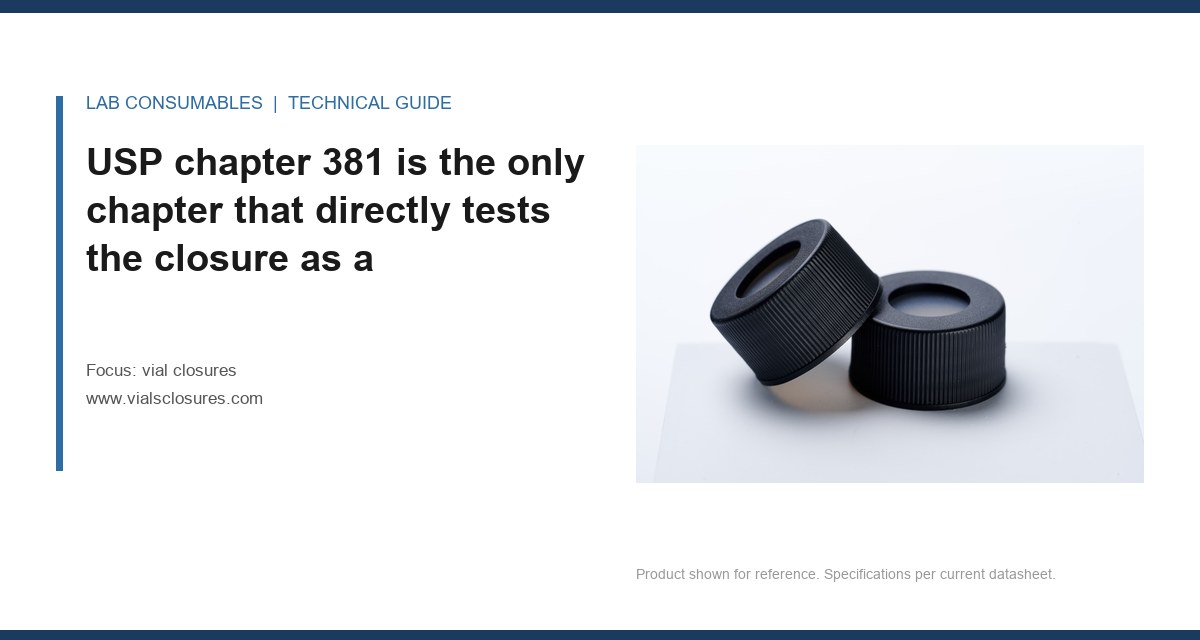
A 10 mL crimp vial run came back with an RSD of 4.8% on a method validated at 1.2%. Nothing in the sample prep had changed. The autosampler was fine. The column was new. The problem was the septum: a lot of “PTFE/silicone” closures that had passed incoming visual inspection but failed the reseal test after three punctures. USP requirements for vial closures in a validated method would have caught this before the run, not after.
USP chapter 381 is the only chapter that directly tests the closure as a closure
Most lab people think USP 661 is the closure chapter. It is not. USP 661.1 and 661.2 are plastic packaging chapters. They test the polymer material, not the assembled closure system. USP 381 is titled “Elastomeric Closures for Injections,” and it is the chapter that actually reaches the finished septum, the stopper, and the crimp cap as a functional unit. If you are validating a method that uses vial closures, 381 is the chapter your quality unit should cite in the method’s consumable specification.
What 381 requires in practice is narrower than most people assume. It does not give you a pass/fail for your exact vial and cap combination. It gives you a set of material-level and functional tests that the closure must survive under defined conditions. The lab still has to write its own dimensional and compatibility spec. That distinction matters when an auditor asks which USP requirement your closures meet.
What USP 381 actually tests
- Fragmentation: the septum must not shed visible particles when punctured with a 21-gauge needle under defined conditions.
- Self-sealing: the closure must reseal after puncture so that no liquid leaks when the vial is inverted under vacuum or pressure.
- Penetrability: the force to push a needle through the septum must stay below a specified maximum.
- Extractables: the closure must not leach more than a defined amount of material into a test solvent under autoclave conditions.
These are not nice-to-have checks. They are the minimum a closure has to pass before it can be called an elastomeric closure for an injectable or a validated analytical method that mirrors injectable handling. If your method is for an oral solid or a raw material, USP 381 still applies the moment you use an elastomeric septum on a crimp or snap vial, because the chapter defines the material class, not the dosage form.
USP 661.2 reaches the plastic cap and the septum’s polymer layer, not the assembled closure
USP 661.2 is the chapter for plastic packaging systems. It applies to the polypropylene cap, the PTFE facing on a laminated septum, and any plastic component that touches the sample or the headspace. The tests in 661.2 are material identity tests, extractables under specific solvents, and heavy metals limits. They do not test puncture reseal, fragmentation, or needle force. That is the gap most labs miss.
A closure can pass 661.2 material tests and still fail 381 functional tests. I have seen a polypropylene cap pass every 661.2 requirement and then crack at 40 N of crimping force because the cap’s skirt wall was 0.35 mm thinner than the drawing called for. 661.2 does not measure wall thickness. 381 does not measure cap dimensions. Your method spec has to cover that.
The chapter split in a validated method
When you write the consumable section of a validated method, you should cite both chapters, but for different components. The septum gets 381. The cap and any plastic liner get 661.2. The glass vial gets USP 660. If someone asks “which USP chapter applies to the vial closure,” the correct answer is “381 for the elastomer, 661.2 for the plastic cap, and 660 for the glass.” That is the complete answer. Saying only “661” is wrong and will cause a finding in a well-run audit.
USP 660 matters because the closure’s glass interface is where dimensional drift shows up first
USP 660 is the glass container chapter. It sets hydrolytic resistance limits, which tell you how much alkali the glass surface releases into water. That matters for pH-sensitive methods, but it also matters for the closure because the vial finish dimension controls how the cap seats. A 13 mm crimp neck that is 0.1 mm under spec will not let a standard aluminum seal compress the septum enough to pass the 381 self-sealing test. The closure did not fail. The glass did. But in the method, the failure shows up at the closure.
For a validated method, I recommend specifying the vial finish as GPI 13-425 or GPI 20-400 for screw necks, and 13 mm or 20 mm crimp neck per ISO 8362-1. The closure spec then references the same GPI or ISO dimension. When both sides cite the same standard, the dimensional interface is controlled. When they do not, you get the drift I described.
What a validated method must specify beyond USP
USP 381 and 661.2 give you material and functional floors. They do not give you everything. A validated method needs a closure specification that includes at least these parameters, with numbers:
- Septum diameter and thickness: for a 13 mm crimp vial, a 13 mm septum at 1.3 mm to 1.5 mm total thickness is typical. For a 20 mm crimp vial, 20 mm at 1.5 mm to 2.0 mm.
- PTFE facing thickness: 0.25 mm to 0.50 mm for HPLC and GC work. Thinner facings puncture more easily but coring risk goes up. Thicker facings resist coring but raise needle force.
- Durometer of the elastomer: 45 to 55 Shore A for silicone, 50 to 60 Shore A for bromobutyl. Softer septa reseal better but fragment more under repeated puncture.
- Puncture count rating: a single-use method can accept a 1-puncture septum. A multi-injection sequence needs a septum rated for 5 to 10 punctures without reseal failure.
- Crimp cap torque or crimping force: for screw caps, 12 to 18 inch-pounds (1.4 to 2.0 N·m) is the working range for 13-425 closures. For crimp caps, 35 to 45 N of jaw force on a calibrated hand crimper produces a seal that passes the 381 self-sealing test without cracking the vial neck.
- Temperature rating: silicone septa are typically rated to 200°C continuous, PTFE/silicone to 200°C, but bromobutyl drops to 121°C for autoclave use. If your method uses a 105°C headspace oven, that is fine. If it uses a 180°C GC inlet, the septum must be rated for that.
This is the part USP leaves to the lab. The chapter will not tell you the puncture count for your method. It will not tell you the torque value for your cap. Those are method-specific parameters, and they belong in the method’s consumable specification, not in a general USP reference.
Why reseal failure is the most common USP 381 failure in real labs
The fragmentation test gets attention because visible particles are easy to see. But the self-sealing test fails more often in practice, and it fails silently. A septum that does not reseal after puncture lets solvent evaporate, lets air in, and changes the headspace composition. In a GC method, that changes the split ratio. In an HPLC method, it changes the concentration of the remaining sample. The RSD drifts up, and the closure looks fine because the leak is microscopic.
USP 381’s self-sealing test specifies puncturing the closure with a needle, then inverting the vial or applying a defined vacuum. If liquid leaks, the closure fails. The test is pass/fail. It does not tell you how close to failure you were. That is why I recommend a quantitative in-house check: puncture the septum 5 times with the method’s actual needle gauge, then weigh the vial, invert it for 24 hours at room temperature, and weigh again. A weight loss of more than 0.1% for a 10 mL vial indicates a reseal problem that USP 381’s pass/fail test will not flag until it is worse.
Field case 1: the 4.8% RSD run
The run I opened with was traced to a septum lot that had a silicone layer 0.15 mm thinner than the previous lot. The PTFE facing was the same. The total thickness was the same. But the thinner silicone layer meant the septum did not rebound after the third puncture. The needle path stayed open. Solvent evaporated from the vial between injections. The measured concentration drifted upward as the run progressed. The fix was a septum spec that required a minimum silicone layer thickness of 0.8 mm, not just a total thickness. USP 381 would not have caught this because the septum passed self-sealing after one puncture. The method’s multi-puncture requirement exposed it.
Extractables from septa are a validated method problem, not just a packaging problem
USP 381 includes extractables testing under defined conditions. The chapter uses specific solvents and autoclave cycles. But a validated analytical method often uses solvents that are more aggressive than the USP test solvents. Acetonitrile, methanol, and methylene chloride extract more from a silicone septum than water does. If your method uses a high-organic mobile phase or a chlorinated extraction solvent, the septum’s extractables profile under USP 381 conditions will understate what actually leaches into your sample.
I have seen a GC method for residual solvents develop a ghost peak at 7.2 minutes after a septum lot change. The peak was cyclic siloxane from the silicone layer. The septum passed USP 381 extractables because the USP test used water, not the method’s DMSO extract. The fix was a septum with a full PTFE facing on the sample side, not just a thin PTFE coating. The full facing is 0.38 mm thick and blocks siloxane migration. The thin coating is 0.05 mm and does not. The method spec now requires “full PTFE facing, 0.25 mm minimum” for that assay.
Field case 2: the ghost peak at 7.2 minutes
The symptom was a reproducible peak that appeared only after the vial sat for more than two hours. The measurement that identified it was a blank vial with the same septum, same solvent, same storage time, injected with no sample. The peak appeared. The septum was the source. The fix was switching to a vial closure with a 0.38 mm PTFE facing and a bromobutyl core instead of silicone. The bromobutyl core has lower siloxane content. The method’s RSD dropped back to 1.1%, and the ghost peak disappeared. This is a case where USP 381 extractables testing alone would not have prevented the failure because the test solvent did not match the method solvent.
How to write a USP-compliant closure spec in a validated method
The method’s consumable section should not say “use a suitable vial closure.” That phrase is an audit finding waiting to happen. It should say something like this:
“Use a 13 mm crimp vial with a 13 mm septum, 1.5 mm total thickness, 0.25 mm PTFE facing on a 0.8 mm minimum silicone core. Septum must meet USP 381 fragmentation and self-sealing requirements. Cap must be 13 mm aluminum with a 0.25 mm polypropylene liner meeting USP 661.2. Crimp with a calibrated hand crimper at 40 N jaw force. Septum is rated for 5 punctures with a 23-gauge needle. Replace septum after 5 injections or 24 hours, whichever comes first.”
That is a spec. It has numbers. It cites the right chapters. It leaves no room for a purchasing agent to substitute a cheaper septum that passes visual inspection but fails the method.
Comparison table: septum material choices against USP 381 and method needs
| Septum material | USP 381 fragmentation | USP 381 self-sealing | Typical puncture rating | Temperature limit | Best method fit |
|---|---|---|---|---|---|
| PTFE/silicone, 0.25 mm facing | Pass if facing intact | Pass up to 5 punctures | 5 to 8 | 200°C | GC headspace, HPLC multi-injection |
| PTFE/silicone, 0.05 mm coating | Pass if coating intact | Pass up to 3 punctures | 3 to 5 | 200°C | Single-injection HPLC |
| Bromobutyl, no PTFE | Pass but higher coring risk | Pass up to 10 punctures | 8 to 12 | 121°C autoclave | pH-sensitive aqueous samples |
| Silicone only, no PTFE | Pass but highest siloxane extractables | Pass up to 5 punctures | 5 to 8 | 200°C | Avoid for GC; use only for aqueous HPLC |
The puncture ratings in this table are from my own incoming QC testing, not from a USP chapter. USP 381 does not specify a puncture count. It specifies a pass/fail self-sealing test after a defined number of punctures, which the lab sets. If you do not set it, the supplier’s default applies, and that default may be one puncture.
What USP 381 does not cover, and where the lab’s own spec has to carry the load
USP 381 does not cover needle gauge compatibility. A 26-gauge needle and a 19-gauge needle produce very different puncture forces and reseal behavior. The chapter uses a defined needle, but your method may use a different one. The lab has to test the closure with the method’s actual needle gauge and record the result.
USP 381 does not cover crimp cap dimensions. A 13 mm cap that is 0.05 mm too tall will not compress the septum enough. A 13 mm cap that is 0.05 mm too short will crack the vial neck. These are dimensional checks the lab or the supplier must perform. The analytical testing lab should include a crimp height measurement in its incoming QC, not rely on the supplier’s certificate.
USP 381 does not cover lot-to-lot consistency. Two lots of the same septum part number can differ in silicone layer thickness, PTFE facing thickness, or durometer. The chapter tests a sample from a lot. It does not guarantee the next lot will match. A validated method needs a lot-change verification step: run a blank, a standard, and a QC sample with the new lot before releasing it for production use.
Operational precautions that keep a validated method inside USP boundaries
Store septa in sealed bags away from solvent vapors. Silicone absorbs acetonitrile and methanol from the air. A septum stored in a drawer next to a solvent cabinet will have higher extractables than the same septum stored sealed. This is not in USP 381, but it changes the extractables profile the chapter measures.
Do not autoclave a septum that is not rated for autoclave. Bromobutyl septa are autoclaved at 121°C for 30 minutes. Silicone septa can be autoclaved but the PTFE facing may delaminate if the cycle exceeds 135°C. Check the supplier’s temperature rating before you put a closure in the autoclave. A delaminated PTFE facing will fail the 381 fragmentation test on the next puncture.
Do not reuse a septum beyond its puncture rating. The rating is not a suggestion. A septum rated for 5 punctures will fail the self-sealing test on puncture 6 or 7. The failure is not always visible. The vial looks sealed. The headspace has already changed.
For HPLC vials, the HPLC vial and closure must be from the same dimensional family. A 9 mm screw closure on a 9 mm vial from a different supplier may not seat correctly. The GPI finish is the same, but the tolerance stack can differ. Test the combination before you validate the method.
Troubleshooting checklist when a validated method drifts and the closure is suspect
- RSD above validation limit: check septum reseal after the method’s actual puncture count. Weigh the vial before and after a 24-hour inversion test. Weight loss above 0.1% indicates a reseal failure.
- Ghost peak in GC: run a blank vial with the same septum and solvent, no sample. If the peak appears, the septum is the source. Switch to a full PTFE facing or a bromobutyl core.
- Visible particles in the sample: check the septum for coring. A 19-gauge needle with a blunt tip will core a 0.25 mm PTFE facing. Use a sharper needle or a thicker facing.
- Cracked vial neck during crimping: measure the crimp jaw force. Above 50 N will crack a standard 13 mm vial. Reduce to 40 N and recheck the seal.
- Evaporated sample after storage: check the cap liner. A missing or torn liner will not seal even if the septum is intact. Replace the cap, not the septum.
This checklist is specific to closure-related failures. It is not a general method troubleshooting list. If the column is bad or the detector lamp is old, this checklist will not help. But if the closure is the variable, these checks will find it.
Where the USP chapters leave off and the supplier’s data has to take over
USP 381 and 661.2 are minimum standards. They do not guarantee that a closure will work in your specific method with your specific needle, solvent, temperature, and puncture count. The supplier’s certificate of analysis should list the actual test results, not just “pass.” A C of A that says “meets USP 381” without numbers is not enough for a validated method. You need the fragmentation result, the self-sealing result, the penetrability force, and the extractables profile under the method’s solvent.
For chromatography methods, the chromatography consumables supplier should provide this data on request. If they do not, find a supplier that does. The Agilent chromatography consumables and columns documentation includes closure compatibility data for their vials. Thermo Fisher chromatography and sample handling resources include septum material guides. Restek technical resources for chromatography publish puncture force and reseal data for their septa. Use these to build your spec, then verify with your own testing.
The U.S. EPA SW-846 test methods for waste and materials include consumable requirements in some methods, but the USP chapters are the primary reference for closure material quality. Do not conflate the two. SW-846 method requirements are method-specific. USP 381 and 661.2 are material-class requirements. Both apply, but they answer different questions.
When a method is validated, the closure is part of the system, not a replaceable commodity. The USP chapters give you the floor. Your spec gives you the walls. The supplier’s lot data gives you the consistency. If any of those three is missing, the method will eventually drift, and the closure will be the last thing anyone checks.
References & further reading
Related resources from our lab consumables network:
- Vial Closures at vialsclosures.com
- Analytical Testing at testinganalytical.com
- Hplc Vial at vialforhplc.com
- Chromatography Consumables at chromatographyconsumables.com
External references and standards: