
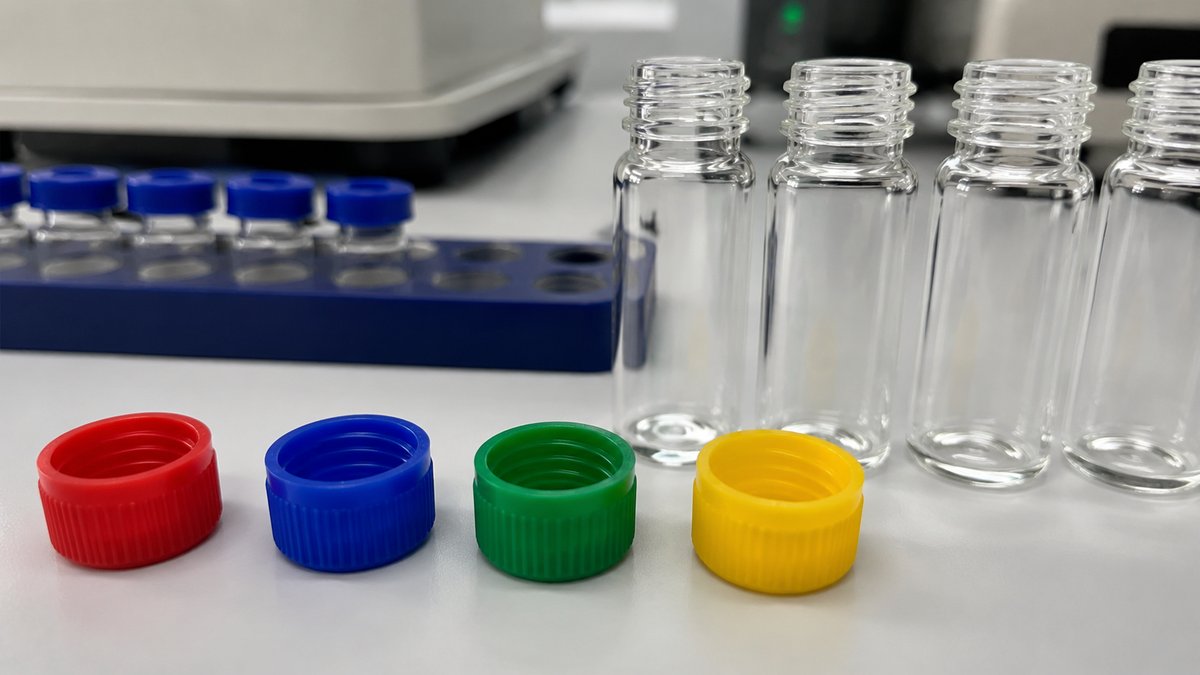
This article examines the technical characteristics of vial caps and discusses how color-coded 9mm short-thread polypropylene (PP) caps provide a low-cost, high-reliability solution for contamination prevention and sample management.
Common Sources of Cross-Contamination in High-Throughput Chromatography Laboratories
Cross-contamination in high-throughput environments rarely stems from a single cause; rather, it results from the interplay of multiple operational and physical factors:
- Sample Misidentification and Position Errors
In 96-position or 54-position vial trays, vials of identical shape and volume are prone to misplacement or mismatched capping—particularly during multi-assay mixed trays, dilution retests, or manual spiking steps. - Reagent and Solvent Cross-Contamination
Different analytical methods impose stringent requirements on solvent purity, pH, and buffer salt concentration. Accidental use of derivatization reagent caps or high-concentration standard caps on blank vials—or incorrect cap usage during repeated aspiration—can introduce trace-level contamination. - Needle Carryover and Septa Bleed
During needle penetration of septa, incompatible septum materials or coring (particle shedding) can cause solvent leaching or particulate contamination of samples. Additionally, repeated punctures of the same cap increase solvent evaporation and exposure to airborne contaminants.
Technical Principles and Contamination-Protection Advantages of 9mm Short-Thread PP Caps
The 9mm short-thread (9-425 thread standard) configuration is the most widely adopted vial neck specification across major autosampler platforms (e.g., Agilent, Waters, Thermo Scientific). Color-coded high-purity polypropylene (PP) caps combine mechanical compatibility with visual management functionality:
- Precision Sealing and Moderate Torque: The short-thread design achieves rated sealing torque with only a half to full turn (recommended torque: 0.15–0.20 N·m). Compared to conventional long-thread caps, short-thread caps significantly reduce septum deformation or thread stripping caused by over-tightening, thereby lowering solvent evaporation and contamination risks.
- High-Purity PP Material and Low Extractables: Premium PP caps are manufactured from medical-grade polypropylene, free from plasticizers such as phthalates. Color caps are produced using high-stability inorganic pigment masterbatches during injection molding, ensuring no pigment leaching in common organic solvents (e.g., acetonitrile, methanol, dichloromethane).
- Ready-to-Use Pre-assembled Septa: Eliminates secondary hand-contact contamination during manual septum insertion and avoids adhesive use, removing chemical interference from adhesive leachables.
Color Assignment Strategy and Standard Operating Procedures (SOPs)
Establishing a clear, rigorous color-coding system is essential to translating physical hardware into effective management control.
Three-Dimensional Color Assignment Matrix
Based on laboratory management requirements, a dimensional isolation approach is recommended for color definition (avoiding ambiguous multi-purpose color meanings within the same workflow):
| Color Code | Recommended Application | Strategic Rationale |
|---|---|---|
| Blue | Matrix blank / Blank control | Baseline background color; represents target-free samples |
| Green | Calibration curve / Standards | Indicates known-concentration high-value reference materials |
| Red | High-concentration QC / Derivatization reagents / Toxics | Warning color; alerts to high-concentration residue and contamination risk |
| Yellow | Retest samples / Abnormal samples | Caution color; distinguishes from normal batches |
| Black/Natural | Routine unknown samples | Bulk analysis for standard daily workloads |
SOP Control Points
- SOP-01: Material Issuance and Preparation
When preparing standards, operators must follow the “one color cap per solution type” principle for cap issuance. Vials containing concentrated stock solutions must use red caps and are strictly prohibited from mixing with routine sample caps. - SOP-02: Pre-Run Dual-Person Visual Checklist
After loading vials into the autosampler tray, perform a “color zone inspection” against the tray map. For example, positions 1–6 must be green (calibration curve), position 7 must be blue (blank). Any black or red cap triggers a run-block and prevents sequence initiation. - SOP-03: Puncture and Disposal Rules
Red (high-concentration) and green (standard) caps are limited to a maximum of 2 punctures. Once punctured or damaged, vials must not be retained as stock solutions to prevent evaporation and cross-contamination.
Multi-Layer Defense with Barcode and Automation Systems
Color coding does not replace barcodes or automation; rather, it serves as the first line of defense (Visual Gateway) complementing technological measures:
- Filling Barcode Scanning Blind Spots
Barcodes can only be read by mechanical scanners; technicians cannot rapidly identify a mislabeled vial among 96 positions by eye. Color coding enables visual anomaly detection within 3 seconds. - Integration with Automated Liquid Handling Workstations
Automated dispensers use color-fixed cap slots when aliquoting reagents or gradient samples. Operators can quickly confirm reagent positions by color during refilling, preventing cross-addition of reagent A into reagent B slots.
Procurement Considerations and Quality Verification Standards
To ensure color-coded 9mm PP caps meet the requirements of high-sensitivity analyses (e.g., LC-MS/MS or GC-MS), the following parameters should be evaluated during procurement and incoming quality control:
Physical Compatibility and Dimensional Tolerances
- Cap Outer Diameter and Height: Outer diameter must be strictly controlled at 11.6 ± 0.1 mm, with a height of 6.0 ± 0.1 mm. Out-of-tolerance dimensions may cause autosampler gripper failure or slippage.
- Center Puncture Hole Diameter: Recommended puncture hole diameter is 6.0 mm. An undersized hole increases needle-strike risk; an oversized hole reduces septum support.
Chemical Inertness and Solvent Resistance Testing
- Pigment Leaching Test: Immerse caps in pure acetonitrile and dichloromethane for 24 hours. UV-Vis spectral scanning of the extract (200–800 nm) must show no new absorption peaks; GC-MS analysis must detect no pigment-derived leachables.
- Low Extractables Verification: Request chromatographic purity reports. Under high-sensitivity LC-MS full-scan conditions, the increase in mass spectral background noise from PP extractables must be less than 5%.
Septum Sealing and Mechanical Performance
- Resilience and Puncture Force: For PTFE/silicone septa, a hardness of 45°–50° Shore A is recommended. Excessively hard septa risk needle bending or coring; excessively soft septa provide insufficient sealing recovery, leading to solvent evaporation.
- Pre-slit Options: For high-frequency injection or blunt-tip needles, pre-slit septa (Y-type or cross-slit) should be selected to reduce puncture resistance while maintaining seal integrity and preventing vial lift-off during needle withdrawal.
Conclusion
Related Resources from hplcvials.com:
- Product: 10-425 Thread Caps with PTFE/Silicone Septa ND10 Vials Closures
- Guide: Top 5 Advantages of Using Tall Screw Thread Chroma…
- Guide: Crimp Vial vs. Snap Vial vs. Screw Cap Vial, How t…
- Guide: 1000ml reagent bottle with GL45 screw caps for sam…
In modern chromatography laboratories pursuing high throughput and high data quality, contamination management depends not only on advanced instrumentation but also on rigorous procedural detail. By implementing quality-compliant color-coded 9mm short-thread PP caps in conjunction with a well-defined SOP color assignment matrix, laboratories can establish an intuitive, cost-effective error-prevention barrier—substantially reducing cross-contamination risks and ensuring accuracy and traceability of analytical results.